
- By Kartik .
- September 29, 2026
Consider RFID when assets go missing often, audit results don’t match your notes, barcode scans slow work down, shrink keeps rising, or you handle assets across multiple locations. With RFID, each asset gets a tag. Readers then record the tag ID and where it was. That happens without needing direct line-of-sight scanning. For asset-heavy companies in the UAE, these five signs indicate when manual tracking stops working.
If an organization spends more time looking for gear than using it, you might not have a staffing issue. You likely have a visibility issue. An RFID asset tracking system is made to address that gap.
What is an RFID asset tracking system?
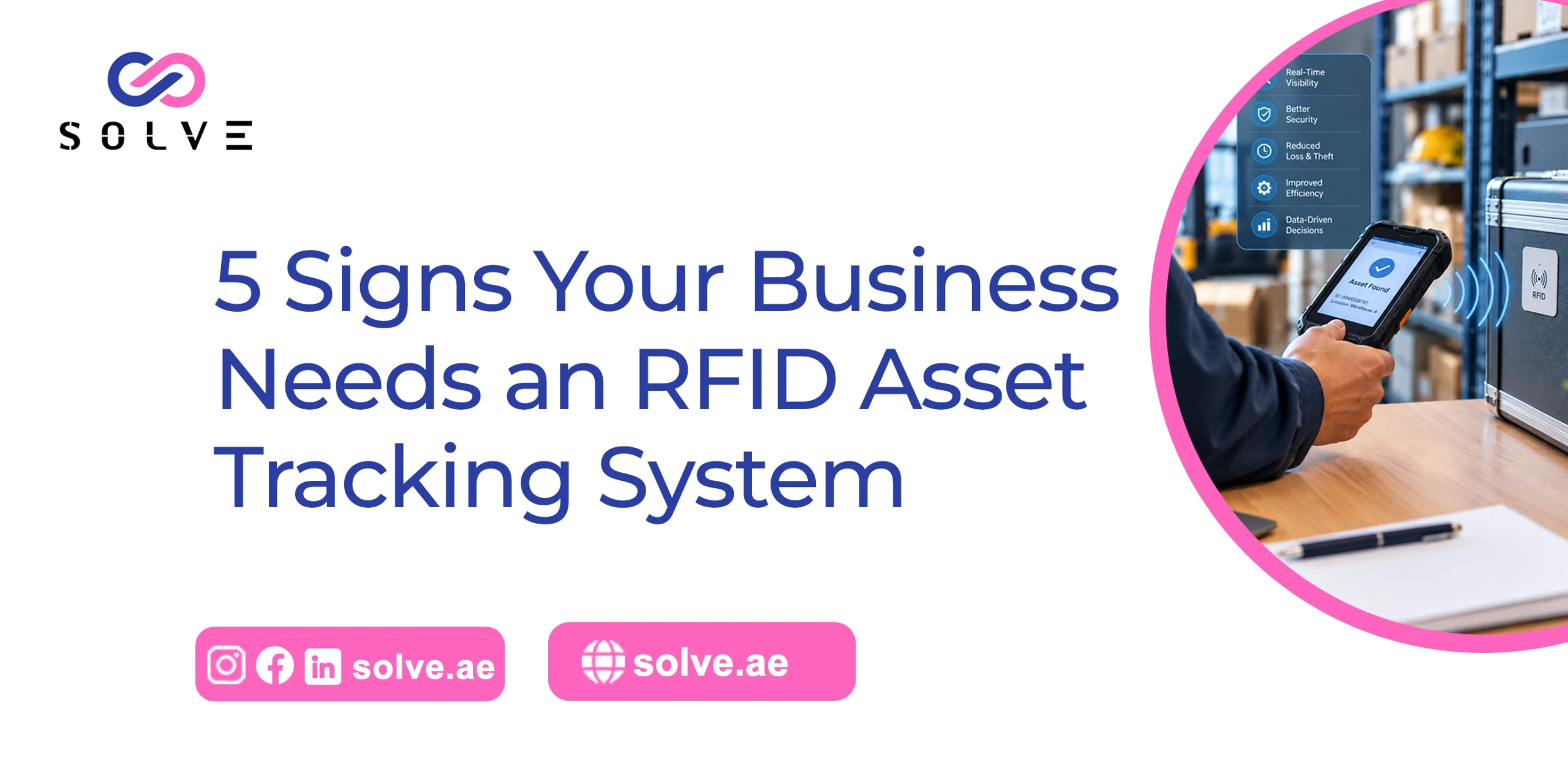
An RFID asset tracking system uses tags, readers, antennas, and software. It finds and tracks items by using radio waves. Tags attach to the assets. Readers pick up the tag data and send it into your software. This can be done in real time. Unlike barcodes, RFID does not require line-of-sight. Also, a single reader can capture data from multiple tags at the same time.
You may want RFID when the cost of not knowing where items are adds up more than the cost to tag and track them. This includes lost time, missing items, and audit failures. RFID may not be the best choice for every setup. If you track under about 1,000 unique assets, a well-run barcode approach can be enough, based on Beam Tracking.
The 5 signs you need an RFID asset tracking system
Sign 1: You and your team spend too long hunting for gear.
When people put in minutes or even hours to find tools or parts, you need a better way to see where things are. Each search costs paid time, and it also keeps the asset idle. Many setup guides tell you to aim for a sharp drop, like going from 2 hours down to 2 minutes. That number is there to show the size of the issue. With RFID asset tracking, a handheld unit or a fixed reader can spot tagged items without staff opening every bin and cabinet.
Sign 2: Your count on-site never matches your file.
If what you see on the floor does not line up with what your system shows, then the way you record inventory is failing. Barcode services often state high accuracy rates, but real cycle counts can fall a lot when tags are missed or labels get covered. Beam Tracking notes that real results may land around 65–85% in these cases. RFID can scan many tags in one go, so you can check a room during a quick walk-through rather than spending a week doing repeated scans.
Sign 3: Stuff goes missing, gets taken, or “gets borrowed.”
If shrink keeps happening, it often means you do not have a solid record of who had an item and when. RFID logs can show where an asset is, who has it, and when it moved. Fixed readers near entrances can also raise an alert if an item leaves an approved area. One provider based in the UAE says firms can cut asset losses by as much as 30%. That is a vendor statement, so it should be used as a goal for a trial. It is not a sure outcome.
Sign 4: Barcodes and spreadsheets fall behind
As more work comes in, manual tracking often fails. Labels tear, smudge, or fall off. Some assets also end up outside in yards, on metal shelving, or next to hot equipment on shop floors. That is when scanning one item at a time gets too slow. People get tired, and some pieces get missed.
CPCON found that RFID pays back faster when the day volume is high. In smaller places, with under 5,000 items per day, the labor savings may not be large enough to justify the switch. If you plan to grow, it is smart to map out an RFID asset tracking setup now.
Sign 5: You run more than one site, or you need audit trails.
When items travel between warehouses, branches, hospitals, or project locations, you need a single, current view. RFID can log each move as it happens, and CPCON says this can shrink check and investigation work from days down to minutes. It can also sync with ERP and asset management tools. That is important for teams in the asset tracking system in the UAE who handle audits, compliance, or finance, since they usually want the data to land in the software you already use.
| If this sounds like you | The gap | What RFID changes |
| “Where’s the laptop/tool/pallet?” | No live location | Search by tag in seconds |
| Audits take days and still don’t match. | Manual, one-by-one counts | Bulk reads in one pass |
| Items disappear without a trace. | No custody trail | Movement logs and exit alerts |
| Labels tear, scans get skipped. | Human-dependent process | Automatic, no line-of-sight |
| Many sites, one spreadsheet | Fragmented data | Central, ERP-integrated view |
Why RFID Asset Tracking Counts
An RFID asset tracking system matters because it reduces errors that manual checks often miss. GS1, as noted by Technowave, reports that RFID inventory tracking can reach more than 99% accuracy. By contrast, basic barcode tracking is often around 65%. Your outcome can change based on the tag you pick, the environment, and how you run the steps. A strong barcode workflow can do better than 65%, but RFID usually holds the edge. The practical gains show up as fewer missing items, fewer audit issues, and fewer write-offs. This is why RFID for business use is used in logistics, healthcare, retail, and facilities.
How to Set Up RFID Asset Tracking in the UAE (Steps)
1) Pick what success means: Start by measuring your current inventory accuracy and how long searches take. Then set a clear goal, like moving from 65% toward 98%.
2) List your assets and map them: Record what the items are, where they sit, and how they move. Keep in mind that metal and liquids can disrupt RFID signals.
3) Run an RF site survey: Appinventiv’s UAE guide treats this as a required step. RFID is a physical setup, so you need to verify real conditions.
4) Choose tags and readers: Use passive tags when you only need short-range reads, like for many inventory items in one area. Use active tags when you need longer-range reads, like for vehicles. If you have items near metal, use on-metal tags.
5) Connect the system to your software: Link the RFID asset tracking system to your ERP, WMS, or asset management tool.
6) Pilot one area first: Test read rates on your actual assets in that zone before you expand.
7) Train the team and roll it out: CPCON suggests giving 2 to 3 months so staff can reach steady performance.
Quick Example: A Simple Picture of the Workflow
This is only an illustration, not a real client outcome. Think of a Dubai facilities business with about 3,000 tools and devices across five sites. Each quarter, audits take around a week per site. Supervisors then buy duplicate items because nobody is able to find the originals fast enough.
Check out our latest blog post on Cost of Building an E-Commerce Website in Dubai
Frequently Asked Question
Q1. What does an RFID asset tracking system do?
It uses tags, readers, antennas, and software to spot and track items. It relies on radio signals. It does not require a clear line of sight.
Q2. When should you pick RFID over barcodes?
Choose RFID when you deal with large volumes, rough settings, repeated count issues, theft risk, or multiple site locations. If you have under about 1,000 different items, barcodes are often enough.
Q3. Is RFID more accurate than barcodes?
In most cases, yes. Reads happen automatically. GS1, through Technowave, reports 99% plus for RFID and about 65% for barcodes. Still, barcodes can improve when the process is well managed.
Q4. What is the cost of an RFID asset tracking system in the UAE?
Global benchmarks list tags at $0.15 to $2 each. Readers are often $1K to $3K per zone. A basic setup for one zone can start at $5K to $10K. Ask for a local quote in AED.
Q5. Will RFID work on metal or in liquids?
It can, but it may not perform well unless you use the right tag type. Look for on-metal tags when the surface is metal. Also test the setup in a trial run.